
By Brian Carey – 13 June 2026
An Irish technology company is being acquired for €400m. Despite 30% revenue growth, its shares halved before the sale. Why did the market get it so wrong?
This is a confession. For the past 11 years it completely escaped my attention that an Irish technology company traded merrily on a stock market in a faraway land. Kneat popped on the Irish media radar only when it announced that it was about to be bought and delist.
The private equity firm Thoma Bravo is to pay a chunky €400 million for the Limerick software company. Quoted on the Toronto Stock Exchange, Kneat is based in Ireland and Irish-run and led. In its quest for world domination, it has taken a road less travelled, successfully debunking myths about Irish companies and our economy, while confirming a couple about the stock market.
Kneat was founded in 2007 by Eddie Ryan, Brian Ahearne and Kevin Fitzgerald, engineers who worked for pharmaceutical multinationals. They decided to start a company to digitise the Himalayan-scale mountains of paperwork created by drug manufacturers. Validation is the documenting of evidence that a company does what it said it would do when producing a drug or stent, right down to how it cleans its equipment and mops its floors. As excruciatingly boring as that sounds, in these massive regulated industries, validation is critical.
Kneat was initially funded through Enterprise Ireland and the employment and investment incentive scheme (EIIS). So far, so normal. By 2015, Kneat’s annual return, including its list of shareholders, ran to 62 pages. It was getting inside some of the biggest names in Big Pharma, but needed to raise capital. An investment proposal came across the desk of the Canadian investor Wade Dawe. This is where the story takes an unexpected turn.
Dawe, a life sciences investor, also held interests in resources, which, in 2015, included Fortune Bay Corp, a Toronto-listed mining company prospecting for gold in Saskatchewan.
First, the EIIS investors were bought out, leaving Kneat’s three founders and a longstanding backer, Eric McGrath, a pharmacist, as shareholders. Fortune Bay then bought Kneat, giving it access to the cash on the miner’s balance sheet. The resources assets were spun out into a newly listed vehicle. Fortune Bay became Kneat.com Inc. The founders and McGrath retained a 68 per cent stake and Fortune Bay shareholders owned the remaining 32 per cent.
Kneat has since followed a land-and-expand business model. Once it landed a client, it would digitise one process, then an entire factory, then all the factories in that company’s manufacturing footprint. It is a software as a service (Saas) company that charges per seat or user. In Biogen, Kneat’s first client, it has grown to 16,000 seats. Eight of the top ten life sciences companies globally are clients. It used its stock market listing to raise C$32 million equity, at increasing valuations, to fund its ambitions. The founders’ stake was diluted, but rose in value. This is how technology companies grow on the stock market. Then, between February 2025 and March this year, despite revenue rising close to 30 per cent last year, and losses narrowing significantly, Kneat.comshares shed more than half their value.
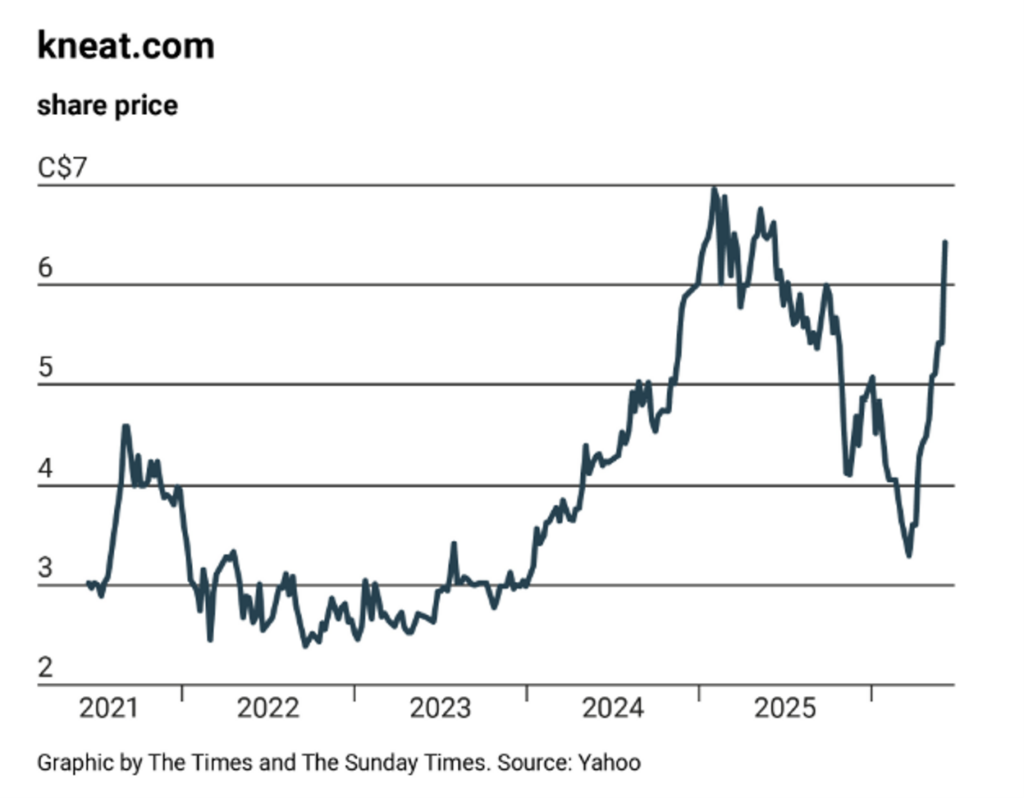
The reason: the Saas crash, when investors became nervous that artificial intelligence would disrupt the earnings of software as a service companies. As Ryan told investors, drug regulation does not really lend itself to managing data in a “probabilistic” manner. AI is not an issue. The stock still got whacked.
Kneat proves that Ireland can produce world-class companies. There is a dividend from multinationals locating here that goes beyond corporate taxes and jobs. It shows capital markets can support the growth of technology companies. It also shows that sentiment, even when it is wrong-headed, is the real killer. Thoma Bravo is taking Kneat off the market below its 2025 peak. The founders and McGrath own a 13 per cent stake worth more than €50 million. The pharmacist backer will land €5 million. Other investors are unhappy and believe the company is being sold cheaply.
If DCC, another Irish company, can’t hack it as a public company, then one wonders who can. It delivered returns of close to 3,000 per cent for investors over its first 20 years on the market. It pivoted to help its huge client base and others transition to green energy, a big growth opportunity. Since 2016, the stock has gone nowhere. Why? Sentiment.
In April last year, I predicted that DCC would get swallowed up by private equity. A €6.6 billion offer for the company by KKR and Energy Capital Partners is on the table. Will it be opposed? At least that one did not escape my attention.
To view the source version of this article, click here.